Overview
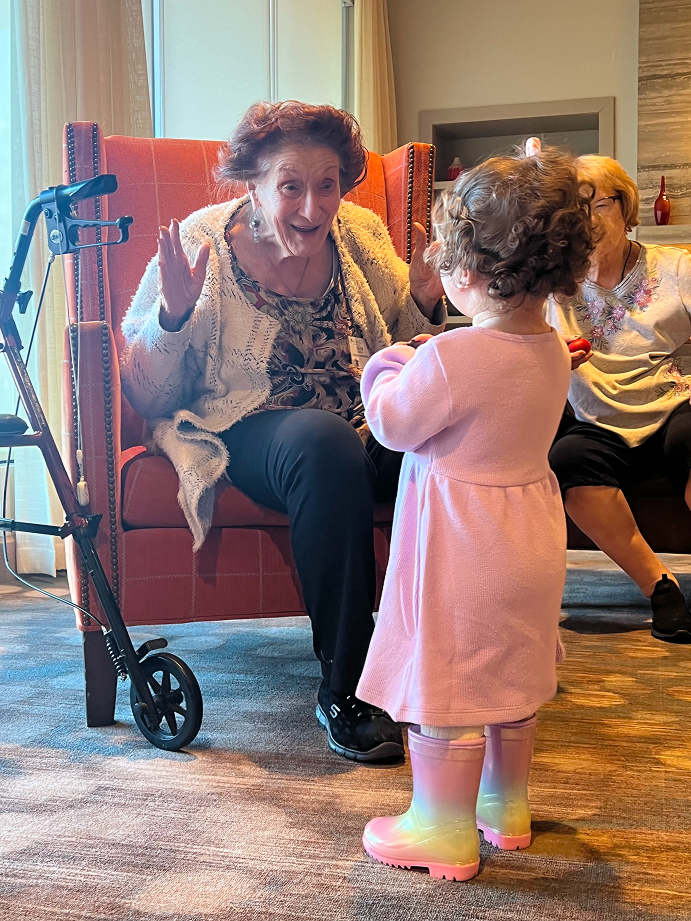
Bach & Boogie is an intergenerational music program that brings babies, caregivers, and older adults together through real classical music and movement.
What started as a small experimental class grew into a repeatable experience system — one that required genuine product strategy, service design, pricing decisions, marketing experiments, and continuous iteration based on what actually happened in the room.
I founded the program and led it end-to-end: from concept through design, testing, rollout, and ongoing refinement. The medium is different from enterprise software, but the work is the same — clarify the problem, understand users in context, design under constraint, and iterate toward something that holds up over time.
The Opportunity
I started playing piano at five and a half. My teacher believed children could learn to play beautiful, challenging pieces — real Chopin, real Bach — and she was right. That early experience planted something in me: the idea that music, offered seriously and joyfully, can change how a room feels.
When I started playing piano with my infant daughter, I watched that same spark ignite in her. My wife noticed it too, and suggested I explore whether there was a class format worth building — something in my own style, with real music at the center.
The classes we'd seen were thoughtful but over-packed: too much instruction, too little room to simply be. Parents spent 45 minutes anxiously corralling toddlers who just wanted to move. The music was simplified, often "kidified." It filled time. It didn't offer anything real. That's where the actual opportunity sat.
Early childhood programming and senior activities also tend to exist in completely separate worlds — which felt like its own missed opportunity. Seniors are often overlooked, quietly removed from the rhythms of everyday life. But music still speaks to them. And when you place that alongside the curiosity and energy of toddlers, something genuinely beautiful happens. The energy flows both ways.
The goal wasn't to build a better music class. It was to design a repeatable, emotionally resonant system that trusted everyone in the room with something genuine.
Real composers. Real orchestras. No gimmicks. No kidified music.
- Ritual, pacing, and attention management across wildly different participants
- Emotional safety and predictability without being sanitized or soft
- Operational simplicity for facilitators — especially in senior living settings
- Durability over novelty — something sustainable, not just interesting once
My Role
As founder and product lead, I owned the full lifecycle — from initial concept through ongoing iteration.
- Defining the core experience and value proposition
- Designing the session structure and content system
- Making pricing and revenue model decisions
- Running marketing and acquisition experiments across channels
- Enabling other facilitators and planning for scale
- Iterating continuously based on observation and feedback
In practice, this looked less like designing interfaces and more like designing a living system — one that had to work for infants, for people with dementia, for tired parents, and for activity directors who needed it to run smoothly without much setup.
Research & Discovery
Research was embedded directly in delivery. There was no separate user interview process — insight came from being in the room.
- Watching parents and children engage (or disengage) during sessions
- Reading senior participants' body language and listening to their comments afterward
- Conversations with caregivers, activity directors, and facilitators across sites
- Noticing exactly where confusion, friction, or drop-off happened — and why
A few things became clear quickly:
Over-instruction killed engagement. People wanted to participate, not follow a script. The moment I explained too much, the room went flat.
Predictable structure created calm. Knowing what came next made it easier for everyone — especially those with dementia or sensory sensitivities — to settle in and stay present.
Fewer choices led to better outcomes. Across every age group.
Adults responded more deeply when treated as full participants. Seniors especially. Not observers. Not recipients. Participants.
Experience Design as a System
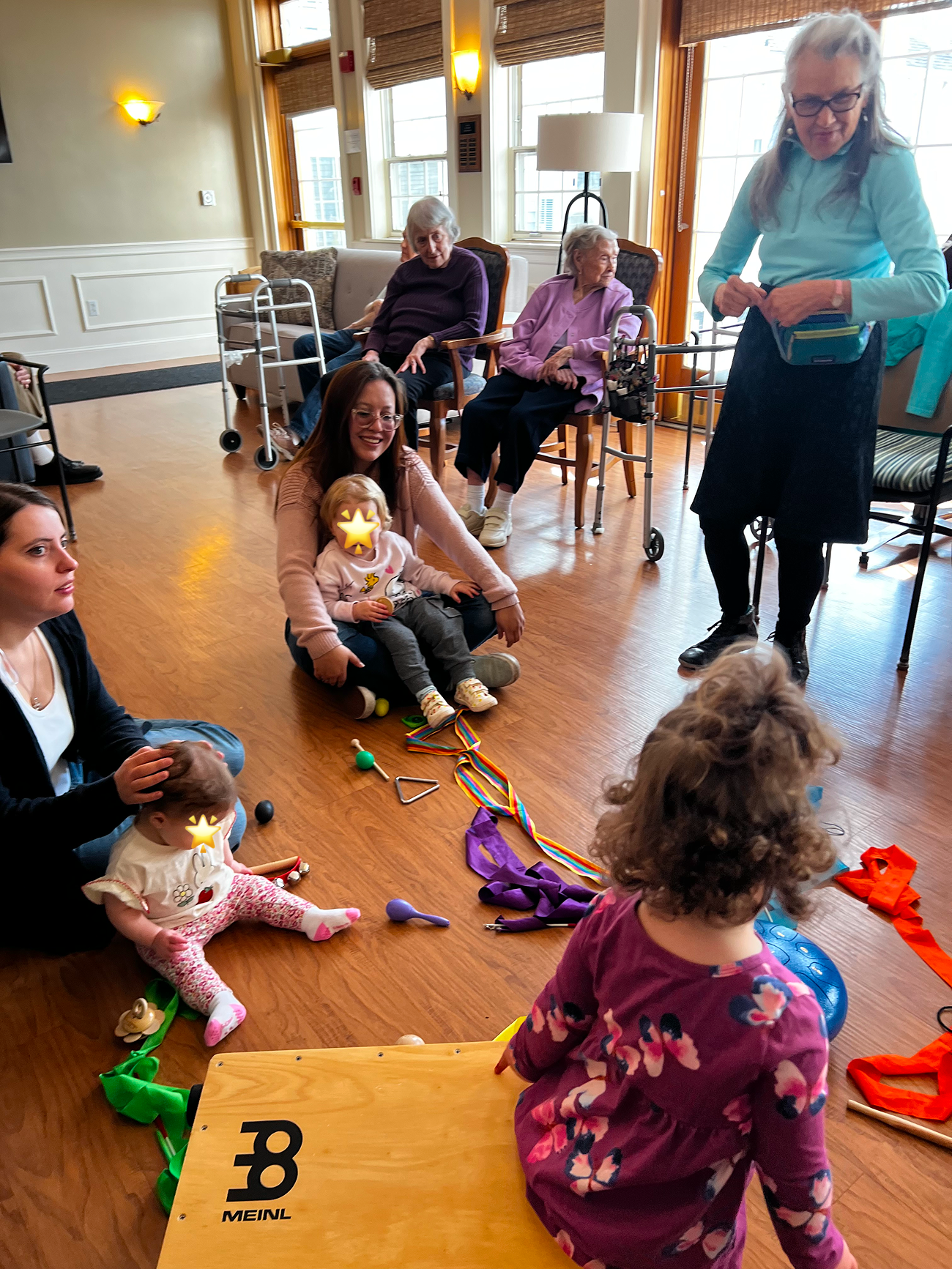
Every Bach & Boogie session follows a contrast-based arc — not a linear build, but a deliberate rhythm of energy, stillness, and release.
Allegro — lively, familiar classical music. Shakers are offered. Movement is invited but never required. This is the entry point: sensory and social, low-pressure. Music is already playing as families arrive and drift in.
Largo — the emotional center of gravity. Calming, slower music. No activity is needed or expected. This is an invitation to lie down, sway, or simply rest. Not a transition — a reset. The room breathes here.
Vivace — energy returns. A single, simple musical concept is introduced briefly and revisited: one idea, sensory and accessible, experienced twice. A short teaching moment — the only one in the class — that gives the session a thread without over-instructing.
Boogie — joyful, familiar music where everyone joins in. Group dance, free movement, communal release. Not a wind-down. The moment the room opens up — shared, slightly chaotic in the best way, across every generation in the space.
The structure functions like a predictable rhythm: people know what's coming, which frees them to actually be present rather than orient. Predictability isn't the enemy of spontaneity — it's what makes spontaneity safe.
The Intergenerational Mechanism
"Intergenerational" is easy to say and hard to design. A mixed audience isn't the same as a designed interaction.
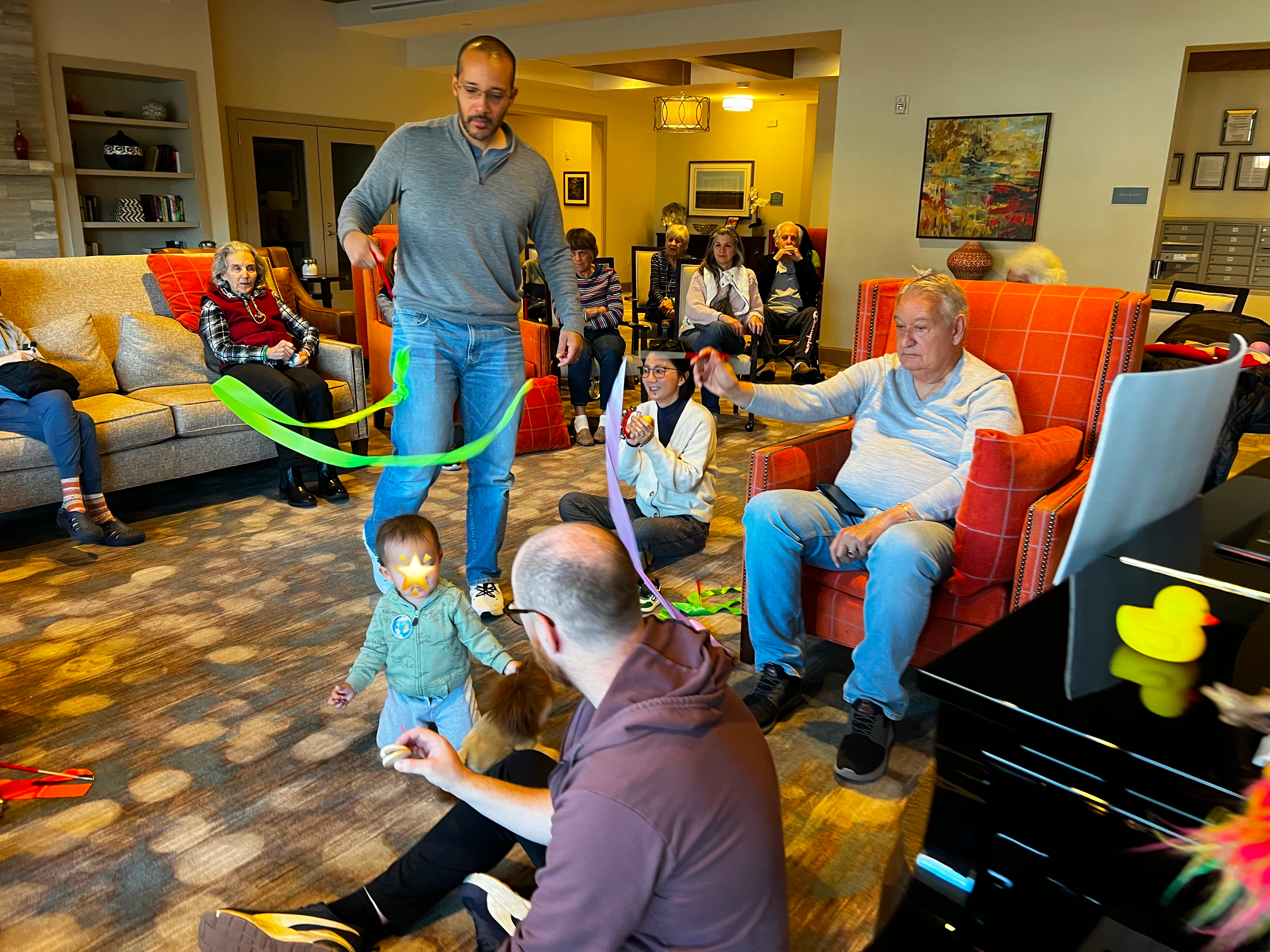
Bach & Boogie uses children as the bridge — literally. During the Vivace, toddlers carry instruments to seniors. The physical object becomes the invitation: low-pressure, dignified, impossible to refuse awkwardly. Seniors can participate or simply receive. Eye contact happens naturally. Real relationships form over weeks.
This matters because it preserves dignity for everyone. Seniors aren't there to be charmed by cute babies. Babies aren't there to perform. The design creates conditions where genuine connection can happen — and then gets out of the way.
After a few sessions, parents and toddlers start to know individual seniors by name. That's the outcome the system is quietly optimizing for.
Product Decisions Beyond the Class
As the program grew, the work expanded into territory familiar from product work — just with faster feedback loops.
Pricing & Value
- Tested single-session vs. series-based pricing across different audience types
- Balanced accessibility with operational sustainability
- Adjusted the model based on venue context — senior facilities, public classes, private events
Marketing & Acquisition
- Ran iterative campaigns on Meta platforms with real budget and real accountability
- Tested copy, imagery, and landing page approaches based on observed conversion behavior
- Evaluated success on return behavior and retention, not just clicks
Iteration & Testing
- Made small, deliberate changes to language, pacing, and structure between sessions
- Used observed behavior — not assumption — to decide what to keep and what to cut
- Codified what worked into repeatable patterns; removed what didn't
Scaling the System
As interest from other facilitators and venues grew, the challenge shifted from delivery to scalability. The same questions come up in enterprise systems design:
- How do you preserve quality without over-specifying?
- What should be standardized? What should stay flexible?
- How do you enable someone else to deliver the experience confidently?
The answer wasn't a script. It was a set of principles:
Clear principles over rigid procedures — facilitators need judgment, not a checklist.
Shared understanding as the actual scaling mechanism — if someone truly understands why the Largo exists, they don't need instructions for it.
Trust in the system rather than control of every execution — the experience holds up when the facilitator understands it, not when they follow it.
The system was designed to scale through comprehension, not compliance.
Reflection
There's a version of this case study that stays entirely in product language. But the honest version acknowledges that Bach & Boogie exists because music has run through my family for generations — a great-grandmother who played piano until she was 99, a grandmother still performing in her string quartet at 87, a mother who sat beside me at the piano every week for years. That lineage informed every design decision, even when I wasn't naming it.
The best design insight I carried into this program came from watching my own daughter engage with music before she could speak: genuine joy doesn't need instruction. It needs space, structure, and something real to respond to.
Whether I'm working on an enterprise dashboard or an intergenerational music class, the questions are the same: What actually matters here? What's creating friction? What does this system need to do to hold up over time?
Running a live program — with real users, immediate feedback, and real consequences for getting it wrong — sharpened my thinking in ways that enterprise work alone doesn't always allow. There's no stakeholder to blame when something falls flat. The room tells you immediately.
I bring that directness back into everything else I design.